


New Ulm's Goosetown Branch, a Model Railroad Design For a Spare Room

Valley Grain in New Ulm, MN, is the embodiment of visual interest, making it an ideal modeling subject. Third Street, on the left, cuts across the entire yard.
I was recently contacted by an existing customer about exploring concepts for a layout to possibly be built in a spare bedroom. He is a lifelong CNW enthusiast, and if I could come up with something along the famed "Alco Line" that would be a plus. With a somewhat blank canvas, I began researching towns up and down "Alco Land". The room was 12' x 11' which is one of the most common spaces I encounter. Since so many other folks likely have similar spaces to work with, I decided to write today's blog about it. Maybe there is an idea or two that you will find helpful. As I started the planning process, it became apparent that the trick was not to overreach. We could do a great job representing one place, but if the scope expanded, we'd have the typical "model railroady" look on our hands.
I began researching towns up and down the line. I wanted something not too large, nor too small. It had to have visual interest and operational potential. I also wanted to find somewhere with a sense of energy and optimism. We found such a gem in New Ulm, MN, a vibrant community of 14,000, about 50 miles southwest of Minneapolis, with a long and rich history. On one end of the New Ulm yard, an industrial branch splits off into the town's "Goosetown" neighborhood. The name comes from early immigrants who arrived in New Ulm and settled into that part of town. For some inexplicable reason, they had a fascination with geese, which apparently ran everywhere. With a name like that, how could you NOT use it?
Although the customer's theme and era is CNW in the late 1970s, if I were building this for myself I'd be very tempted to model the modern era.

After playing around with various footprints, I settled on the design shown above. It would have been possible to run a stub peninsula down the middle also, but I felt we had enough already and I didn't want to break up the sight lines.
Let's take a tour of the area starting in the upper right of the plan.

First up is Valley Grain, a complex of four distinct structures loaded with great logos and weathering. In this image, the viewer is standing in Third Street (which crosses ALL of the yard tracks).
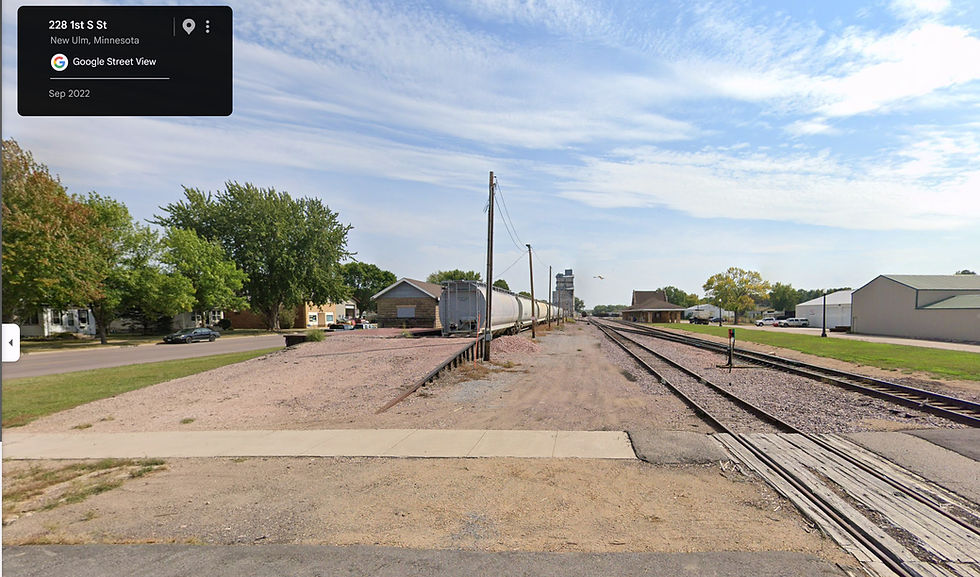
Moving two blocks down the line, we have the First Street team track, an industry that could take almost any type of car imaginable.

Moving to the next wall, we have New Ulm Roller Mill, shown in the 1915 postcard above. It was a complex of three structures framing Center Street. There are some great shots of this scene in the CNW books, unfortuantely it is no longer standing. On this layout, it would no longer be rail-served.

Moving counter-clockwise, we have two elevators, the famous and often photographed Eagle Roller Mill and New Ulm Elevator behind it. I chose to spread them out a little on the design so the view wouldn't be blocked. Eagle is no longer rail-served, but New Ulm Elevator is.

Zooming in, we see this rotting loco behind the elevator. At one point there were two of them. From the lettering, it appears at some point they were Soo Line and then later on a shortline. While not in service, if I were modeling this, I'd take some liberties and make them operational. If you Google Eagle Roller Mill, you'll find a lot more images and some better shots of the locos.

At the end of the line, the rails sink into the earth. I made a plausible guess that the industry was lumber-related and labeled it as such.

Here's a period topo. map to get you oriented. The blue box marks "Goosetown". If you dig around on the rail fan sites, you'll find tons of additional images, and there are some great ones!


